How AI Systems Decide Which Lawyers To Recommend

People looking online for a lawyer is nothing new. For decades, your potential clients have relied on search engines to tell them which law firms might suit their professional needs. However, though people are still looking online for the same reasons, the technologies that assist them have evolved rapidly.
AI-driven search engines can not only find local law firms but also recommend the best fit for an individual user. Because of these technological advances, firms now have to satisfy AI preferences to get noticed and referred. This means boosting online credibility signals for maximum visibility.
Understanding AI search systems in legal contexts
AI works on algorithms and data points.
An algorithm is, in essence, a set of instructions, working through steps to complete a task. Designers of AI search engines train the AIs to follow reasoning stages to arrive at a recommendation for a search result. Data points are what the AI uses at various steps in the algorithm to decide which search result is better than another.
Let’s say one step in the AI reasoning process is to calculate online reviews. Information from various review sites, including star ratings, influences how a law firm scores on that data point.
So while your online marketing is essential, AI doesn’t just trust every attorney who says they are the best at what they do. Instead, to evaluate firms to recommend, it also looks to credible third-party sources that are objective and unbiased, such as legal directories and user-generated information sites.
A law firm with a robust website has only scratched the surface when it comes to credibility signals. Outside verification of the law firm’s trustworthiness and authority also matters to the AI.
The Mechanics of Entity Recognition
Before an artificial intelligence system can recommend your law firm, it must first understand exactly who you are and what you do. This process is known as entity recognition. AI does not read websites like a human; instead, it maps out relationships between distinct “entities,” such as people, places, and organizations.
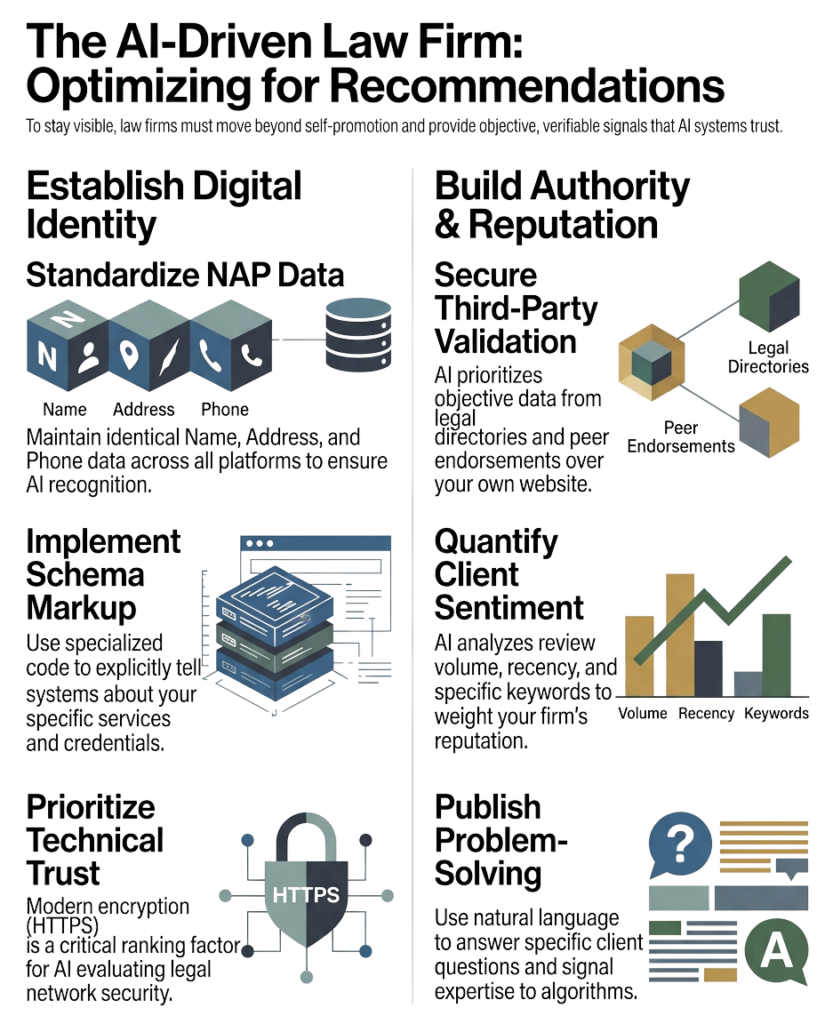
To establish your firm as a recognized entity, data consistency is paramount. AI algorithms actively scan the internet for your firm’s Name, Address, and Phone number (NAP). If your NAP information is identical across your website, your Google Business Profile, local directories, and social media platforms, the AI confidently registers your firm as a verified entity.
Conversely, if an algorithm finds conflicting data—such as a former office address listed on a local chamber of commerce site, or a missing suite number on a legal directory—it becomes confused. To ensure proper entity recognition, audit your online presence and correct any discrepancies. Furthermore, implementing schema markup (a specialized code added to your website) explicitly tells search engines about your specific legal services, location, and attorney credentials. This technical upgrade helps the AI categorize your firm accurately, minimizing disruption and maximizing your search visibility.
Establishing Robust Authority Signals
Once an AI system recognizes your firm, it immediately seeks to determine your level of expertise. Authority signals are the digital indicators that prove you are highly knowledgeable in your specific practice areas.
In the past, optimizing a website meant stuffing pages with relevant keywords. Today, AI utilizes natural language processing to evaluate the depth, accuracy, and context of your content. To generate strong authority signals, your firm can publish comprehensive content that addresses the precise questions your prospective clients are asking.
When a regulatory change occurs in your state, publishing a clear, accessible guide explaining how this impacts local businesses or families sends a authority signal to search engines. Explain technical terms simply and focus on practical applications. By consistently offering clear value and solving problems through your content, you position your firm as an industry leader. This approach not only signals authority to AI but also enhances client outcomes by educating prospects before they even schedule a consultation, thereby reducing administrative overhead for your intake team.
The Mathematics of Reputation Weighting
Trust has always been critical in legal marketing, and today it matters more than ever. Trust determines whether a consumer will even reach out in the first place. AI systems quantify this trust through a process called reputation weighting.
Reputation weighting is how AI measures the quality and volume of your firm’s online feedback. It does not simply count the number of five-star reviews you have; it performs complex sentiment analysis to understand the context of client testimonials. The algorithm looks for keywords within reviews—such as “professional,” “efficient,” “secure,” or “successful outcome”—to gauge true client satisfaction.
Furthermore, AI systems value recency and consistency. A law firm with a steady influx of positive reviews over a sustained period carries far more reputation weight than a firm that received fifty reviews three years ago and none since. To capitalize on this, firms should implement automated, polite review requests following the successful conclusion of a case. Showcasing high client retention rates and positive feedback directly feeds the AI the reputation signals it needs to confidently recommend your services to new prospects.
Securing Third-Party Validation
An AI system operates with a healthy dose of skepticism regarding self-promotional content. Anyone can build a website and claim to be the best attorney in the region. Therefore, AI looks for third-party validation to confirm your claims.
Third-party validation occurs when established, high-authority domains vouch for your law firm. In the legal sector, this primarily takes the form of comprehensive profiles on reputable legal directories like Martindale-Hubbell, Avvo, and Super Lawyers. These platforms have spent decades building domain authority. When they link back to your website and verify your bar admissions, practice areas, and peer reviews, they pass a portion of their credibility on to you.
Peer endorsements are particularly impactful. When other attorneys validate your skills on professional networks, AI algorithms register this as a definitive mark of expertise. Additionally, earning backlinks from local news outlets, regional bar associations, or community organizations further solidifies your standing. Securing this third-party validation is a highly cost-effective method to boost your credibility without straining a limited marketing budget.
Building Network Trust and Security
Data security is no longer just an IT concern or an ethical obligation; it is a major ranking factor. AI systems evaluate the technical foundation of your website to determine your overall network trust.
Law firms handle highly sensitive personal and financial information. If your website lacks modern data encryption standards—specifically, if it is not secured with an SSL certificate (HTTPS)— search engines can flag it as unsafe. A warning label on your website instantly destroys prospect trust and guarantees that an AI system will never recommend your firm.
Beyond basic website security, promoting your secure client communication tools can also build trust. While AI cannot see inside your secure client portals, mentioning that your firm utilizes encrypted document management and secure communication platforms on your public-facing site signals professionalism and a commitment to client data protection. By highlighting how your integrated systems secure your communications and streamline operations, you assure both prospective clients and search algorithms that your firm operates at the highest standards of modern legal practice.
Share:
Actionable Steps to Enhance AI Credibility
Understanding these signals is only the first step. To adapt to evolving legal demands and ensure your firm remains competitive, put this knowledge into practice. Implementing the following steps will help you build a highly credible digital footprint:
- Conduct a Thorough Data Audit: Review your firm’s NAP consistency across the entire internet. Ensure your information is completely uniform on your website, Google Business Profile, social media, and all legal directories.
- Optimize Your Legal Profiles: Claim your listings on all major legal networks. Provide exhaustive details about your practice areas, fill out complete attorney biographies, and actively request peer endorsements to secure vital third-party validation.
- Publish Problem-Solving Content: Focus on answering the specific legal questions your clients ask most frequently. Break down complex regulatory changes into simple, actionable advice. Use clear, structured headings and logical reasoning to build authority.
- Implement a Review Strategy: Do not leave your reputation to chance. Create a systematic process for requesting client testimonials at the close of successful matters. Respond professionally to all reviews to demonstrate active engagement.
- Prioritize Technical Security: Verify that your website is fully secure, mobile-friendly, and loads quickly. Technical proficiency ensures that your network trust remains high, preventing algorithmic penalties.
Adapt your marketing to client behaviors in an AI-driven world
AI-driven platforms follow algorithms and data points to decide which law firms to recommend to your potential clients. To stay competitive, your digital marketing should speak to these credibility signals. Contact Martindale-Avvo today to discover how you can become more visible to AI systems and keep your practice thriving.