AI Visibility: Why Consistency Matters for Law Firms

Why Consistency is the Cornerstone of AI-Driven Visibility
Building a law firm that clients can trust requires significant effort and dedication. When individuals need legal assistance, they are often under stress and feel vulnerable. They seek an attorney they can rely on. However, before they can trust you, they must first be able to find you.
Artificial intelligence is fundamentally transforming how prospective clients search for legal advice. Generative AI engines analyze your online presence to determine if your firm is a reliable source worth recommending. When your firm’s information is clear and consistent across all digital platforms, AI engines gain confidence in recommending your services. Our data shows 86% of AI search results for legal services cite legal directory networks.
Read the Whitepaper: Why Law Firms in Legal Directories Dominate in Google & AI Search
Managing your digital footprint may seem overwhelming, particularly given the demanding nature of legal practice. However, implementing systematic steps to organize your online identity can significantly impact your firm’s visibility and boost its efficiency. This analysis explores why consistency is critical for AI visibility and how you can establish control over your firm’s digital footprint.
How AI Understands Your Legal Identity
AI tools do not process websites the same way humans do. They systematically scan the internet for patterns, data points, and signals. Their objective is to provide users with the most accurate and helpful answers possible. To achieve this, AI models search for “identity signals.”
Identity signals are data elements that confirm your professional identity like practice areas, location, contact information, memberships, awards, publications, and more. When an AI model discovers identical information about your firm and attorneys across multiple websites, it builds confidence in your legitimacy. The system determines that your law firm is a genuine, active, and authoritative source.
Inconsistent signals create confusion for AI systems. For example, if your website lists one phone number while a legal directory displays another or you list ten practicing attorneys in divorce and legal directories only list five, the AI loses confidence in your information. When an AI engine cannot determine which information is accurate, it will bypass your firm and recommend competitors instead.
The Four Pillars of a Consistent Online Presence
To establish trust with AI systems, you must focus on four fundamental areas. Maintaining identical information across these platforms is essential for strong AI-driven visibility.
1. Legal Directories
Legal directories represent some of the most trusted sources on the internet. Platforms such as Avvo, FindLaw, Super Lawyers, and Martindale-Hubbell are highly regarded by consumers, search engines and AI models.
When your firm and attorney profiles on these directories match each other and your website information, it sends a powerful signal to AI systems that you are a legitimate practice. Ensure your practice areas, firm name, contact details, attorney information, and more are identical across every directory where you appear.
2. Your Law Firm Website
Your website serves as the foundation of your digital identity. It functions as the primary source of information that AI models use to understand your firm and attorneys.
Every page on your website should present consistent information. From the footer that should clearly display your firm’s name, address, and phone number to the details provided on your homepage, contact page, “About Us” section, and individual attorney pages.
3. Citations Across the Web
A citation is any online location where your firm’s information like name, address, and phone number are mentioned together. This includes local business listings, news articles, and social media pages.
The consistency around the information about your firm and attorneys is critically important for local search visibility. When a prospective client asks an AI assistant for a “personal injury lawyer near me,” the AI examines your citations, and the information contained within, to confirm things like your practice areas, location, contact information, and more.
4. Structured Schema
Schema markup is code implemented on your website to help search engines and AI models collect structured data about your content. Consider it a direct and indirect communication method with AI systems.
Schema markup allows you to specify exactly what type of law you practice, identify your attorneys, confirm your office location, and more. It eliminates ambiguity and reinforces the identity signals for your firm and attorneys.
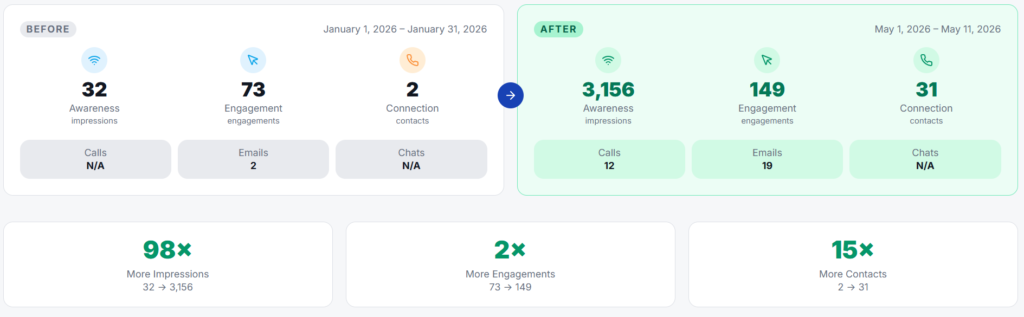
Side-by-side program performance comparison illustrating the impact of AI visibility optimization.
Read More: How AI Systems Decide Which Lawyers to Recommend
How to Audit and Fix Your Digital Footprint
Comprehensive improvement does not require immediate, wholesale changes. Implementing systematic, incremental steps can significantly enhance your firm’s online health. Here is how you can begin auditing your presence to ensure maximum visibility.
Start With Firm/Attorney Profiles Audit
Create a spreadsheet and document the essential information about your firm and attorneys (i.e. names, practice areas, contact information, etc). This will serve as your master record.
Search for your law firm and attorneys on Google and examine major business locations platforms where your firm and attorneys are mentioned. For example, review your Google Business Profile, Facebook page, Yelp, and Bing Places listings. Update any listing that does not match your master record.
Claim and Clean Up Directory Profiles
Compile a list of the top, trusted legal directories (i.e. Avvo, FindLaw, Super Lawyers, Martindale-Hubbell, Lawyers.com, etc.) and search for your firm and attorneys on each platform. Some directories create automatic profiles based on public records.
If needed, claim these profiles so that you can perform updates at the firm and attorney levels. Ensure that all information is filled out and is consistent with other sources. Profile comprehensiveness at the firm and attorney levels is key for creating strong identity signals that search engines and AI models use, and ultimately improves the consumer experience for the potential clients who find your profiles.
Review the Information on Your Firm’s Website
The information on your firm website, including your homepage, practice area pages, About page, individual attorney pages, Contact page, and more, need to establish and convey the correct and strong identity signals behind the firm and its attorneys. Keep these pages regularly updated with the correct information and matching to legal directories.
Set Up a Regular Monitoring Schedule
The internet continuously evolves, and new citations can appear without your knowledge. Establish a quarterly calendar reminder to review your digital footprint.
Regular monitoring helps identify minor errors before they impact your AI visibility. Maintaining current information protects your firm’s reputation and ensures that prospective clients who need your services can locate you.
By maintaining clear and consistent legal identity signals, you build trust with both AI engines and prospective clients. Establishing a consistent online presence will help you achieve the visibility your expertise deserves.