AI Reshapes Legal Search 2025: How Clients Find Attorneys in the Age of Search 2.0

The foundation of the attorney-client relationship has always been trust. In the modern legal marketplace, however, the process of building that trust begins long before the first consultation. A comprehensive analysis of client behavior reveals that individuals seeking legal representation now engage in a multi-platform evaluation process, relying on a wide array of digital signals to assess a firm’s credibility and expertise. This shift in behavior, accelerated by technological advancements like AI-assisted search, has made a transparent and consistent online presence an essential component of client acquisition.
The Multi-Source Investigation by Prospective Clients
In today’s AI-driven environment, the path prospective clients take is dynamic and rarely follows a straight line. Rather than moving from search to a single point of contact, clients engage in a continuous process—moving across search engines, law firm websites, professional profiles, and AI-generated summaries before reaching a decision. Throughout this journey, trust-builders such as verified reviews, client ratings, and peer recognition play a decisive role in shaping whom they choose to contact.
A critical challenge emerges because many of these interactions are invisible to traditional analytics. AI-powered search overviews now bring trust signals directly to the search results page, empowering prospects to compare and decide without ever needing to click through to a website. Additionally, a significant portion of outreach happens through channels such as a firm’s website, Google Business Profile, or a saved contact number—actions that are not captured in standard attribution models.
The Impact of AI-Assisted Search on Client Decisions
The client evaluation process is being fundamentally reshaped by the integration of artificial intelligence into search engines. AI is increasingly used to synthesize vast amounts of information and present users with consolidated summaries directly on the search results page. This development has profound implications for how law firms are discovered and compared.
A significant finding from recent data indicates the speed of this transformation. In March 2025, one in five Google searches already returned an AI-generated summary. These summaries pull data from across the web—including a firm’s website, its directory listings, and client reviews—to create a concise, comparative overview.
Video Visualizer
The Decisive Role of Trust-builders
Throughout their multi-source investigation, prospective clients are fundamentally looking for trust signals. These are the specific pieces of evidence that validate a firm’s claims and provide assurance of its competence and reliability. The research underscores that decisions are heavily influenced by the presence and quality of these signals.
Key trust-builders include:
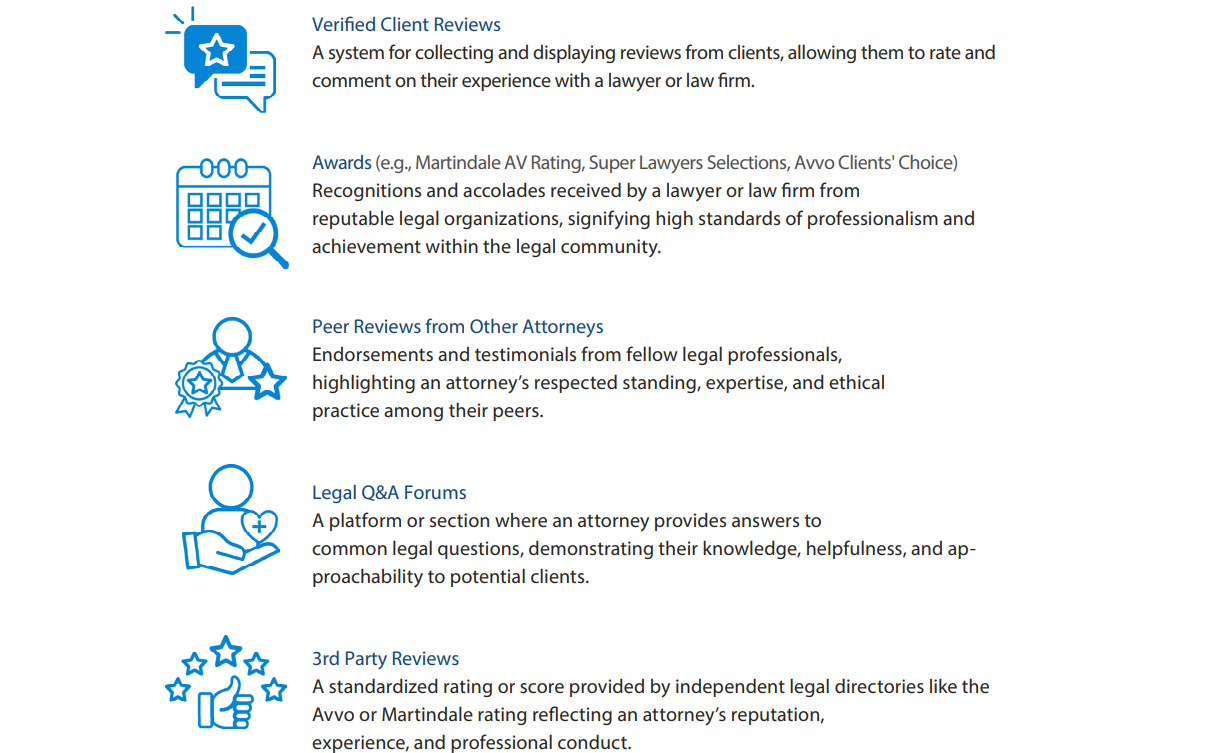
These signals collectively build a narrative of credibility. When a prospect encounters consistent, positive trust signals across multiple platforms, it instills the confidence needed to move forward and make contact. In an environment where clients have more information available than ever before, these markers of trust have become the ultimate currency in legal marketing.
Interested in learning more?

Download our exclusive white paper, “AI Reshapes Legal Search,” and discover why last-touch attribution is failing your firm in the age of AI search. Learn how to measure the full value of your online presence and prove your marketing ROI with confidence.
Inside the report, you will discover:
- The Flaws of Last-Touch Attribution: Understand why conventional tracking methods fail to capture the full influence of your online reputation in an era of AI search and zero-click decisions.
- The Power of Trust-builders: Learn which credibility signals—from verified client reviews to peer endorsements—are most decisive in a potential client’s journey.
- The True Contacts Multiplier: Uncover our proprietary, research-backed formula (True Contacts ≈ Tracked Profile Contacts × 2.1) that reveals the total number of client contacts your reputation actually drives.