The State of the Legal Consumer 2026: From SEO to GEO, How AI Is Reshaping Legal Client Acquisition

The rise of generative AI means that potential clients are no longer just sifting through blue links on a results page. They are interacting with AI Overviews that summarize answers, curate lists of attorneys, and validate expertise without the user ever visiting a law firm’s website. For attorneys at small to medium firms, understanding this shift is no longer optional—it is a requirement for survival in a market where 61% of American adults have used AI in the past six months.
This evolution requires a pivot from traditional Search Engine Optimization (SEO) to Generative Engine Optimization (GEO). The goal is no longer just securing a website visit; it is about ensuring your firm’s trust signals are strong enough to be cited by the AI models that now act as the gatekeepers of legal information.
The Decline of the “Search and Click” Era
The most immediate impact of AI on legal marketing is the reduction of organic traffic. When Google’s AI Overviews appear at the top of a search result page, they provide immediate answers. Consequently, the click-through rates (CTR) for top-ranking pages drop by approximately 34.5%.
Potential clients are increasingly satisfied with the summary provided by the AI. If a user asks, “What do I do after a car accident in Texas?” the AI provides the steps. If they ask for local personal injury lawyers, the AI provides a curated list based on ratings and proximity. This “zero-click” behavior means your firm needs to be part of the answer the AI generates, rather than just a link below it.
Google is even testing features that turn mobile search into a persistent chat, encouraging users to ask follow-up questions within the interface. This keeps the user in the search ecosystem longer and pushes your website further down the priority list.
The Three Stages of the Modern Legal Journey
To adapt, firms must understand the three recurring moments in the 2026 legal consumer journey: Orientation, Validation, and Engagement.
Orientation: The Silent Research Phase
Before a consumer ever picks up the phone, they are educating themselves. Research finds that 92.4% of legal consumers are likely or very likely to research their issue before contacting an attorney.
During this phase, they act as their own researchers, jumping between articles, FAQs, and AI chats to understand the severity of their problem. Your role here is often invisible. Your content helps shape the AI summaries they read, even if they don’t land on your blog immediately.
Validation: The Hunt for Social Proof
Once a consumer realizes they need professional help, they move to validation. This is where your digital reputation becomes your most valuable asset.
Almost 70% of consumers say online reviews are the most helpful element when shortlisting an attorney. They look for specific “trust containers”—verified profiles on platforms like Avvo, Google Business Profiles, and SuperLawyers. If your firm lacks recent reviews or clear practice area definitions on these platforms, you may be filtered out by both the human consumer and the AI algorithm.
AI models rely on these third-party platforms to verify that your firm is legitimate and authoritative. A spotless 5.0 rating isn’t always necessary—and can sometimes look suspicious—but a consistent volume of recent, authentic feedback is non-negotiable.
Engagement: Speed as a Trust Signal
The final hurdle is engagement. This is where many qualified leads are lost due to operational inefficiencies.
Responsiveness is a critical hiring factor. According to one article, 47.6% of consumers listed it as key, while slow response times were cited as the top deterrent to hiring a lawyer. In an era of instant gratification, a response time measured in days is a deal-breaker.
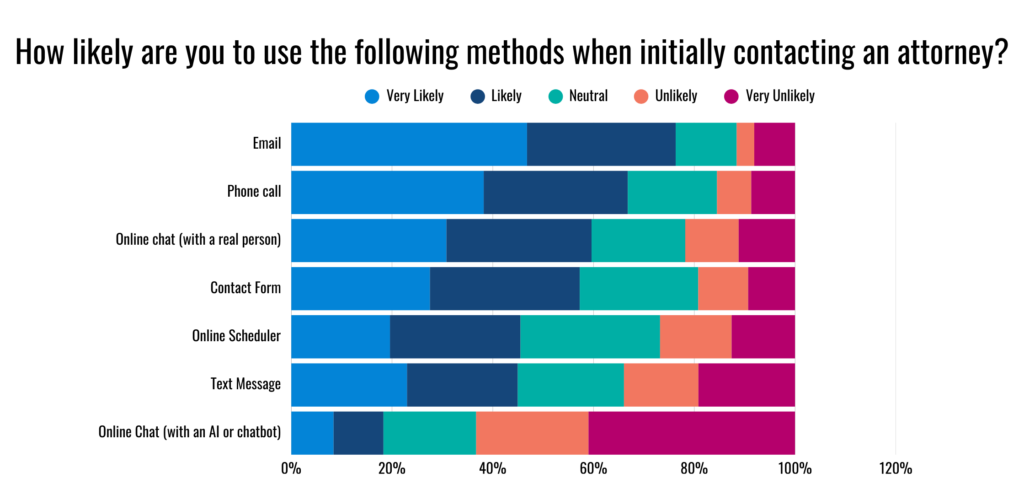
Modern intake is the front line of your brand. Consumers expect a seamless transition from their digital research to a human conversation. Whether it is through email (the preferred initial contact method), phone, or live chat, the response must be rapid and empathetic.
The Hidden Influence of Reputation
Attorneys often underestimate the effectiveness of their marketing because they rely on traditional analytics that only count direct clicks. However, the influence of a strong reputation extends far beyond what a dashboard can show.
New data reveals a “True Contacts Multiplier” of approximately 2.1. This means that for every ten contacts directly tracked from a profile, roughly eleven more are happening off-platform. A potential client might see your profile, read your reviews, and then type your firm’s name directly into Google Maps to call you, or use a saved referral number.
In an AI-first world, this multiplier is likely to increase. An AI Overview might surface your firm’s rating and phone number directly in the summary. The client calls you, and your analytics software reports it as a “direct” or “organic” lead, completely missing the fact that your reputation management strategy was the actual driver.
Strategies for the AI-First Law Firm
Adapting to this landscape does not require a massive budget, but it does require a strategic shift in how you manage your firm’s presence.
Optimize for Data, Not Just Humans
Treat every place your firm appears online as part of a unified discovery system. Your profiles on major legal directories must be complete and consistent. AI systems use structured data—like practice areas, years of experience, and location—to determine relevance. Ensure your bios are concise and highlight specific outcomes and recognitions.
Turn Reputation into a Managed Asset
Move from passively hoping for reviews to actively managing them. Implement a system to request reviews from satisfied clients at the close of every matter. Prioritize recency and volume over perfection. Respond to reviews professionally; this signals to future clients (and algorithms) that you are active and attentive.
Engineer Rapid Intake
Your intake process should be built around speed. Set firm-wide standards for response times—aiming for hours, not days. Utilize automation to acknowledge inquiries immediately, but ensure a human follows up quickly. The goal is to signal competence in that crucial first interaction.
Adapting to the New Reality
The shift to AI-mediated search is not a temporary trend; it is a fundamental change in consumer behavior. Legal consumers in 2026 expect instant clarity, visible credibility, and quick responses.
For small to medium law firms, the opportunity lies in agility. You can adapt your intake processes and reputation management strategies faster than larger, bureaucratic competitors. By focusing on building a robust digital footprint that satisfies both the AI algorithms and the human need for trust, you position your firm to capture the clients who are asking, not just searching.