AI Pitfalls for Attorneys: How to Avoid Hidden Dangers
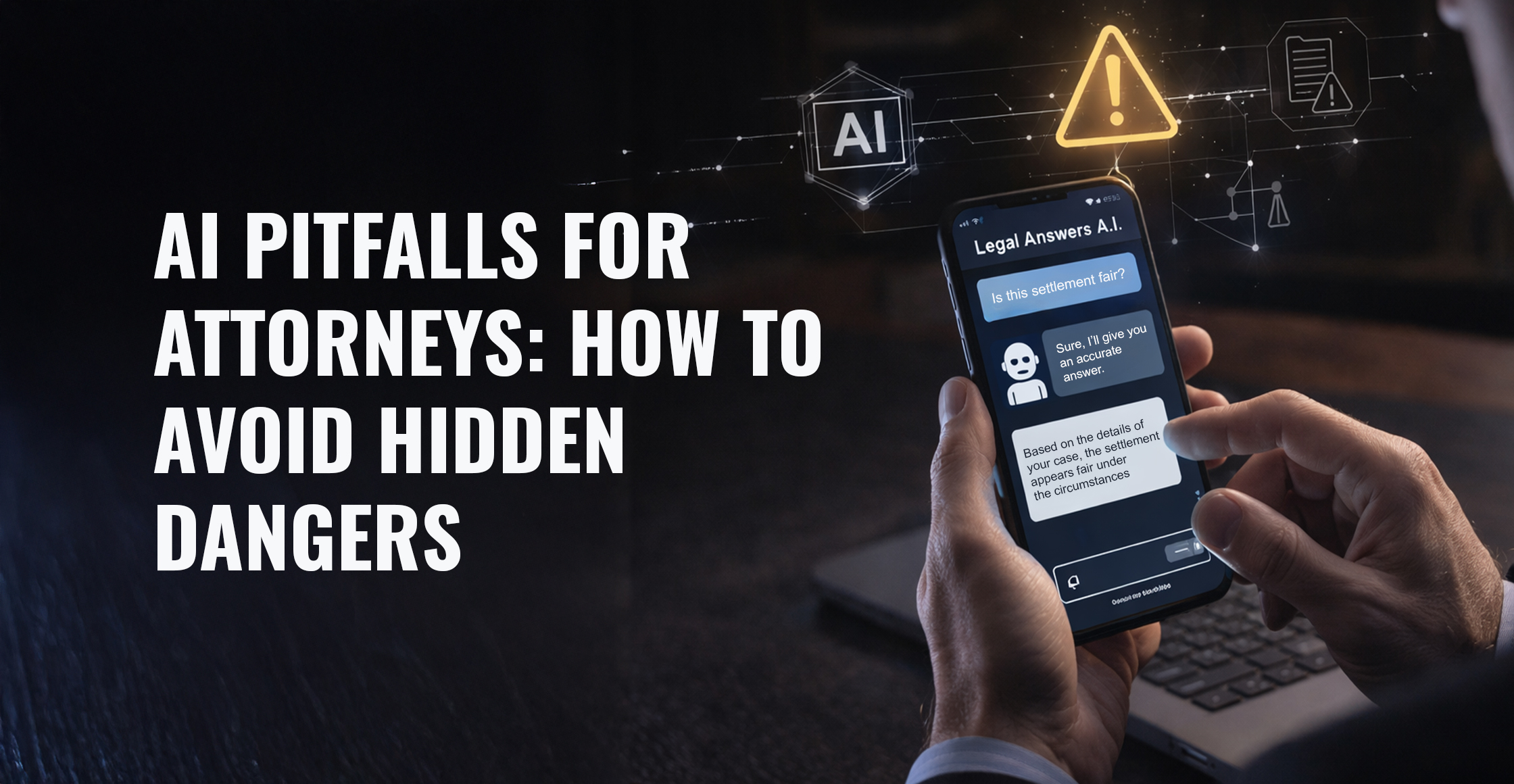
Artificial intelligence is rapidly moving from a theoretical concept to a practical tool within the legal sector. AI promises to streamline research, automate administrative work, and enhance firm efficiency. For small and medium-sized law firms, the pressure to adopt these technologies to maintain a competitive edge is significant. However, integrating AI without a clear understanding of its limitations can introduce serious risks.
While the potential benefits of AI are substantial, a rushed implementation can lead to severe ethical breaches, client data failures, and irreparable damage to a firm’s reputation. It is an unfortunate fact that a single mistake involving flawed legal analysis or a breach of confidentiality can have devastating consequences. This article outlines the most critical AI pitfalls attorneys face and provides actionable advice to help your firm navigate AI adoption responsibly and effectively.
1. Ethical Breaches and Client Confidentiality
An attorney’s foremost duty is to protect client confidentiality. This principle is directly challenged by the use of many public-facing generative AI tools. Platforms like the free version of ChatGPT often use the data entered into them to train their underlying models. This means any sensitive client information, case details, or privileged documents uploaded could become part of the AI’s knowledge base and potentially be exposed.
This practice is in direct conflict with the Model Rules of Professional Conduct. As the American Bar Association (ABA) notes, lawyers must understand the risks AI can pose to client confidential data and the potential for inadvertently waiving attorney-client privilege. Using an unsecured AI model for case-related work constitutes an ethical breach that can lead to malpractice claims and disciplinary action.
How to Mitigate the Risk:
- Establish a Strict AI Policy: Create and enforce clear firm-wide guidelines that prohibit using public AI platforms for any task involving confidential client information.
- Invest in Legal-Specific AI: Opt for enterprise-grade AI solutions designed for the legal industry. These tools operate within a secure, closed environment, guaranteeing your firm’s data remains private.
- Conduct Regular Training: Educate all attorneys and staff on the ethical duties of confidentiality and how they apply specifically to AI.
2. Inaccuracy and Over-Reliance on AI Output
Large language models (LLMs) are engineered to generate plausible-sounding text, not to verify facts or provide accurate legal citations. This can lead to a well-documented phenomenon known as “hallucinations,” where an AI confidently fabricates information, including non-existent case law and statutes.
The legal community has already seen real-world consequences of this pitfall. In one widely reported case, a New York law firm faced court sanctions for submitting a legal brief that cited six entirely fictitious cases created by an AI. Another incident in Australia saw a senior lawyer apologize to a judge after filing submissions in a murder case that included fake quotes and non-existent legal precedents generated by an AI. These examples serve as a stark warning.
Relying on unverified AI output without independent human review is not just poor practice—it amounts to professional negligence.
How to Mitigate the Risk:
- Mandate Human Oversight: Every piece of AI-generated content must be thoroughly reviewed, fact-checked, and verified by a qualified attorney before use.
- Use AI as a Starting Point: Treat AI as a highly capable research assistant, not a final authority. Use it to generate initial drafts or summarize documents, but always perform independent research to confirm its accuracy.
- Understand the Tool’s Limits: Ensure your team knows that AI models do not “understand” the law. They are powerful pattern-recognition systems, and this distinction is critical for responsible use.
3. Data Privacy and Security Vulnerabilities
Beyond the ethical duty of confidentiality, law firms have a legal obligation to protect client data. Integrating any third-party AI tool into your firm’s workflow creates a new potential entry point for cyberattacks and data breaches. If your AI provider’s security is compromised, all the client data your firm has processed through its platform could be exposed.
This risk is magnified for firms handling highly sensitive information related to finance, healthcare, or trade secrets. A data breach can trigger significant financial penalties under regulations like GDPR and CCPA, not to mention the catastrophic loss of client trust and reputational damage.
How to Mitigate the Risk:
- Perform Rigorous Vendor Due Diligence: Before adopting any AI tool, scrutinize the provider’s security protocols, data encryption standards, and compliance certifications. Request and review their Service Organization Control (SOC) 2 report.
- Review Data Processing Agreements: Carefully examine the terms of service to understand exactly how your data will be stored, used, and protected. Ensure the provider contractually guarantees the security of your information.
- Isolate and Anonymize Data: Whenever possible, avoid uploading raw, sensitive documents to an external AI platform. Utilize tools that can operate within your firm’s secure network or that allow for data anonymization before processing.
4. Algorithmic Bias and Lack of Transparency
AI models learn from the vast datasets they are trained on. If that data contains existing societal biases related to race, gender, or socioeconomic status, the AI will learn and perpetuate them. In a legal context, this can have profound and damaging consequences. For example, an AI tool used in eDiscovery might be biased in how it flags documents related to certain demographic groups.
A related challenge is the “black box” problem. With many AI systems, it is impossible to understand the reasoning behind a specific output. If you cannot explain why an AI reached a particular conclusion, you cannot fully trust or defend its use in a legal setting. This lack of transparency, as highlighted by the ABA, makes it difficult to identify and correct for hidden biases.
How to Mitigate the Risk:
- Question the Data Source: Ask potential AI vendors about the data used to train their models. Be skeptical of tools that lack transparency regarding their training data.
- Test for Biased Outcomes: Before full deployment, conduct internal tests using hypothetical scenarios to check for biased results.
- Prioritize Explainable AI (XAI): Whenever possible, favor AI solutions that offer some level of transparency into their decision-making processes.
5. Erosion of Core Legal Skills
While AI can certainly boost efficiency, an over-reliance on these tools poses a long-term risk to the profession: the erosion of fundamental legal skills. If junior associates lean too heavily on AI for legal research and brief writing, they may not develop the critical thinking, analytical reasoning, and persuasive writing abilities that are the hallmarks of a skilled attorney.
The ability to construct a nuanced legal argument or identify the subtle implications of a precedent is honed through years of practice. Delegating these core tasks entirely to an AI could stunt the professional development of the next generation of lawyers, ultimately diminishing the quality of legal services.
How to Mitigate the Risk:
- Integrate AI into Training: Use AI as a teaching tool. Have junior associates critique AI-generated summaries, identify flaws in AI-drafted arguments, or use AI to explore research paths before conducting their own deep analysis.
- Maintain Active Mentorship: Senior attorneys must continue to mentor junior lawyers, providing direct feedback on their research, writing, and analytical skills.
- Balance Efficiency with Development: Use AI to handle repetitive, low-value tasks, freeing up attorneys to focus on the higher-value strategic work that requires human judgment and expertise.
Navigate the Future with a Strategic Approach
Artificial intelligence offers immense potential to enhance the practice of law, but it is not a cure-all. For attorneys at small and medium-sized firms, successful adoption requires a cautious, strategic, and informed approach. By understanding these pitfalls and implementing clear policies, training, and oversight, you can leverage the power of AI to boost firm efficiency while upholding your ethical obligations and protecting your clients.
To stay ahead, law firms need a marketing partner that understands the evolving legal landscape. Martindale-Avvo provides a suite of solutions designed to connect your firm with qualified prospects. From building your reputation across our unparalleled legal network to delivering pre-screened leads, we help you grow your practice.